
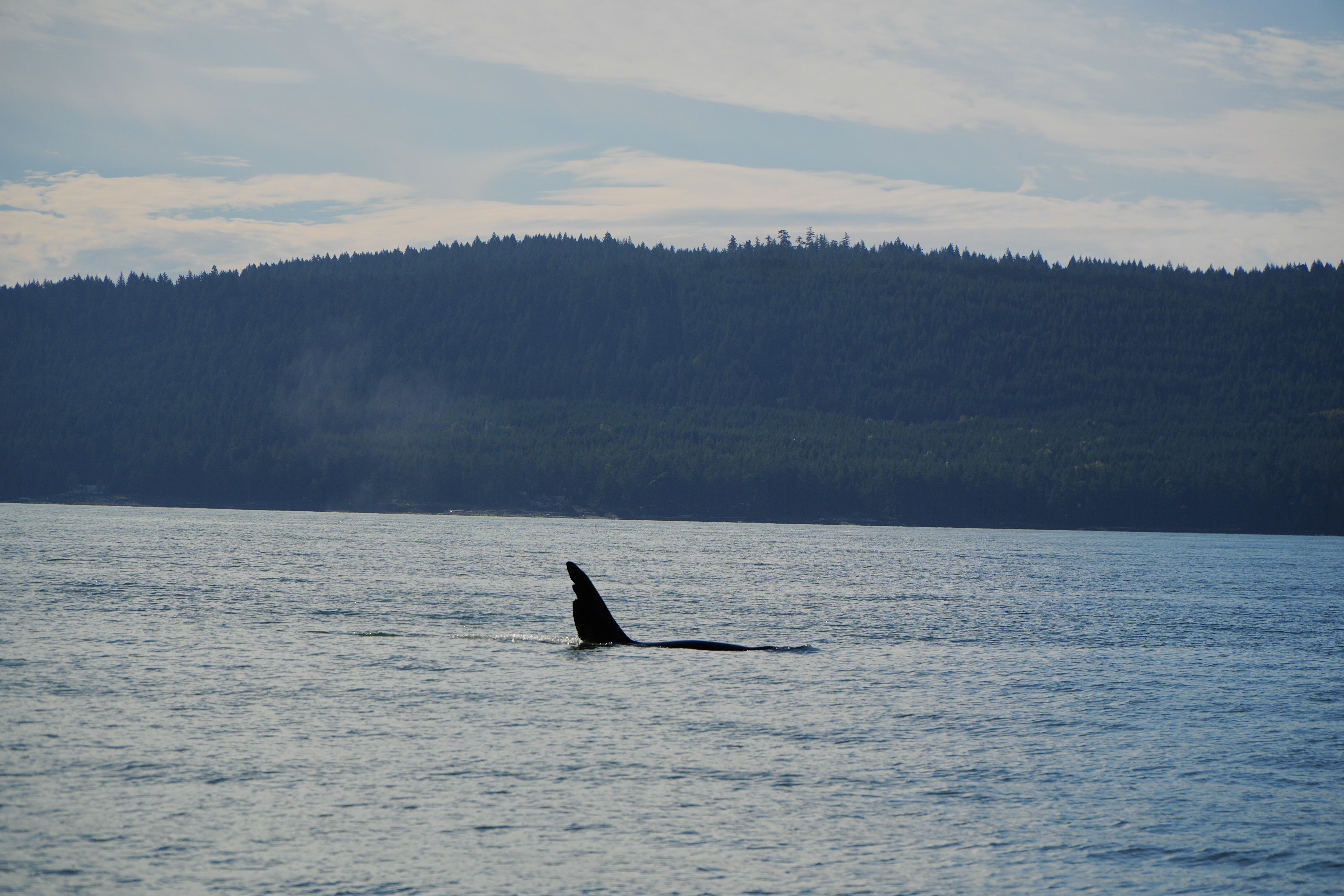
Researchers Jared Towers and Chloe Kotik witnessed the death of a Northern Resident Orca, I76, in August of 2025. This encounter was written up and published as an academic note in Marine Mammal Science.
Jared Towers is the Executive Director of Bay Cetology, a research group run out of Alert Bay off the coast of Vancouver Island, British Columbia, and Chloe Kotik is a PHD student at the University of Alaska Fairbanks focusing on anthropogenic threats to killer whale health and population dynamics.
The two were alerted to Northern Resident Orcas in Johnstone Strait and went out to observe the pod with the intention of recording what is usually a basic encounter. After arriving on scene, it was apparent that one of the whales in particular, a male I76, was not in good shape. Initial photos of I76 showed major signs of emaciation just behind his blowhole, as you can see in figure 1.B below.

Figure 1. (A) 28-year-old Northern Resident killer whale I76 (left) with several Pacific white-sided dolphins and humpback whale BCZ0419 (right) on August 16, 2025. Photo: Scott Turton. (B) I76 shows severe emaciation behind the cranium and along the dorsum on August 17, 2025. Photo: Chloe Kotik. (C) Aerial view of I76 on August 17, 2025, shortly before his disappearance. Photo: Jared Towers.
I76 was with his mom I4, younger sister I102, and nephew I174. Of the four, he was the only one with physical signs of distress which indicated to Jared and Chloe that whatever was affecting him was individual and not visibly shared amongst the pod.
The whales weren’t alone during this encounter. Initially followed by two humpback whales, I76 and his family attempted to create distance between them, only to be met by a significant pod of Pacific white sided dolphins. Neither of these species are particularly harmful to Orcas, but they can still cause problems for them.
After 2 hours with the humpbacks, then dolphins, the four Orcas dove in an attempt to create distance from the others. The dolphins would leave, and only 3 Orcas returned to the surface. I76 would not surface again.
His family stayed in the area for 2 hours, diving, vocalizing and swimming slowly, until ultimately making their way East.
Being able to record this encounter is something that hasn’t been published as of yet, making this academic note the first of its kind in that light.
If you want to read more stories about Orcas, feel free to check out this blog and the monthly publication The World of Orcas Zine.